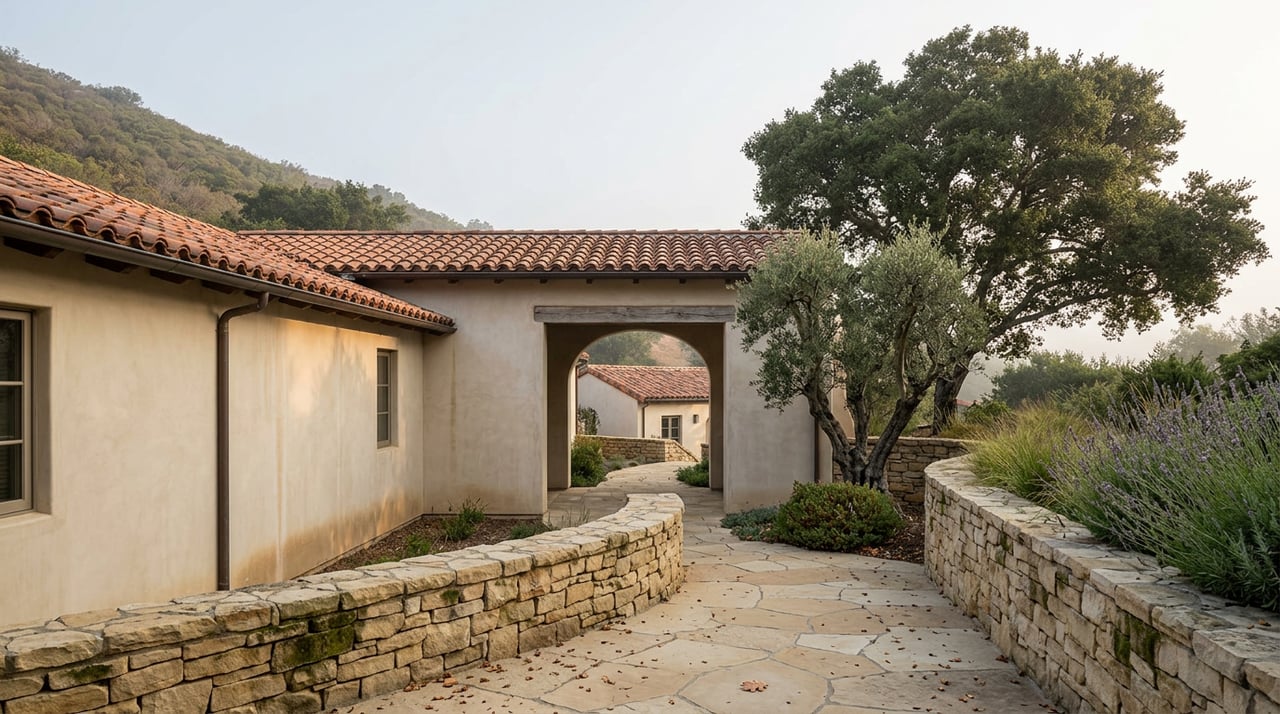
La Cañada Flintridge Sits Entirely in a Fire Hazard Zone. That Blocks Lot Splits, Not ADUs.
September 24, 2026
September 24, 2026
I get some version of the same question from foothill sellers and investors almost every month: if my lot is in a Very High Fire Hazard Severity Zone, does that kill my options for adding a unit? The honest answer is that it depends entirely on which unit you mean. In La Cañada Flintridge, the zone that covers every single parcel in the city treats an accessory dwelling unit and a Senate Bill 9 lot split as two completely different problems, and most people evaluating a property here don't realize that until they're deep into a permit application.
Pull up La Cañada Flintridge on the state's fire hazard viewer and you won't find pockets of risk tucked against the hillsides while the flats stay clear. The city's own multi-family housing page states it plainly: since all of La Cañada Flintridge is within the Very High Fire Hazard Severity Zone, every Senate Bill 9 application in the city has to clear the fire-hazard criteria written into Government Code Section 65913.4. That's not a hillside caveat. That's a citywide condition, and it's the starting point for understanding why the two most common paths to a second unit here don't behave the same way.
An ADU and a Senate Bill 9 project sound like cousins. They aren't governed by the same law, and the city's own municipal code treats them very differently once fire hazard zoning enters the picture.
Chapter 11.33 of the municipal code, which covers ADUs and JADUs, doesn't disqualify a lot because it sits in a Very High Fire Hazard Severity Zone. Fire safety shows up as a site-level construction question instead. A converted structure can skip a new setback if the existing side and rear setbacks are already sufficient for fire safety, as determined by the local fire agency. Sprinklers are required in a new ADU only if the primary residence already has them. Parking gets sited around fire and life safety conditions rather than being denied outright because of the zone.
Chapter 11.85, which governs urban lot splits and two-unit "urban dwellings" under Senate Bill 9, reads differently. It states directly that a proposed urban lot split must not be located in a very high fire hazard severity zone unless the site complies with all fire-hazard mitigation measures required by the adopted building and fire codes. Urban dwellings carry an added layer: any project located within the areas the city's draft Safety Element identifies as having a single point of access must demonstrate compliance with the fire code's apparatus access standards before it can move forward.
Here's the comparison in plain terms:
| ADU / JADU (Ch. 11.33) | SB 9 lot split or two-unit (Ch. 11.85) | |
|---|---|---|
| VHFHSZ treatment | Site-specific fire safety review, not a blanket bar | Parcel is excluded unless fire-hazard mitigation measures are met |
| Access requirement | No separate access test | Single point of access areas face an added fire apparatus access standard |
| Sprinklers | Only if primary residence already has them | Governed by building and fire code compliance for the new parcel |
| Practical effect | Most single-family lots remain eligible | Many hillside or limited-access lots are not eligible without mitigation |
If you're comparing two properties, the fire zone status alone won't tell you which one has more upside. A lot with one narrow shared driveway and no second way out might be a poor SB 9 candidate because it can't clear the access and mitigation bar in Chapter 11.85, while that same lot is still a perfectly workable candidate for a detached ADU, a garage conversion, or a JADU carved out of existing square footage, because Chapter 11.33 never asked the access question in the first place.
I've walked properties where the owner assumed the fire zone designation had closed every door. It hadn't. It had closed one door and left another one open, and the difference mattered for what the property could realistically support, whether that's rental income, a caretaker unit, or space for family. For anyone weighing renovation against new construction, that distinction changes the math before you spend money on plans.
Part of what makes this worth checking rather than assuming is how often the underlying rules have moved. La Cañada Flintridge has amended or replaced its ADU chapter five times in six years: Ordinance No. 519 in 2020, an urgency ordinance (505-U) in November 2022 after the state flagged inconsistencies, a regular ordinance (511) in May 2023, a repeal and replacement (527) in May 2025, and most recently Ordinance No. 535, adopted June 16, 2026. Some of that churn tracks the state's own recodification of ADU law, which moved provisions out of the old Government Code Section 65852.2 and into new sections like 66332, 66333, and 66314. Whatever guide you read on this topic, check the date on it. A page written even eighteen months ago may be describing an ordinance the city has since repealed.
The fire hazard zone boundaries aren't static either. CAL FIRE's Office of the State Fire Marshal released updated Local Responsibility Area fire hazard severity zone maps for Los Angeles County on March 24, 2025, the first update in roughly a decade. State law requires the county to adopt those maps by ordinance within 120 days, and the county fire department has said it expects the number of parcels affected by the new boundaries to grow, not shrink.
That update landed in the same stretch of time the Governor issued an executive order suspending Senate Bill 9 within the mapped boundaries of the Palisades and Eaton fires, citing the same very high fire hazard severity zone framework this article is built around. La Cañada Flintridge sits outside both of those burn perimeters, so that specific suspension doesn't apply here. But it's a signal of where state and county policy is heading on hillside development, and it's worth watching if you're planning a project with a multi-year runway.
If you're evaluating a foothill parcel for its unit potential, a few questions are worth answering before you assume either path works:
Does the whole city being in a fire hazard zone mean I can never split my lot? No. It means any urban lot split needs to satisfy the fire-hazard mitigation measures built into the building and fire codes, or the application won't clear Chapter 11.85's threshold. Some lots can meet that bar. Others can't without work most owners haven't budgeted for.
Will the 2025 map update affect an ADU I already have permitted? The update is aimed at new construction standards and future applications rather than retroactively pulling permits already issued. If you're planning a new application, though, confirm the parcel's current zone status before you design around an assumption.
Is a JADU treated any differently than a full ADU under these fire rules? A JADU is built entirely within existing space in the primary home or an existing accessory structure, which keeps it out of the new-construction fire code triggers that apply to detached units. That's often the fastest, least complicated path on a lot where the fire zone status makes a detached structure or a lot split harder to justify.
If you're looking at a foothill property and trying to figure out what it can actually support, I'd rather walk it with you and check the current code than let you plan around a guide that's already out of date. That's the kind of groundwork Ed Dorini has built a career on, and I'm happy to put it to work on your address specifically. Let's Connect.
October 8, 2026
October 1, 2026
September 24, 2026
September 17, 2026
September 10, 2026
September 3, 2026
August 27, 2026
August 20, 2026
August 13, 2026
Ed works very hard for his clients in helping achieve their goals. Ed has the sophistication and experience needed to capture the attention of the affluent buyers you need to reach, negotiate our best deal and manage your transaction to a successful closing.