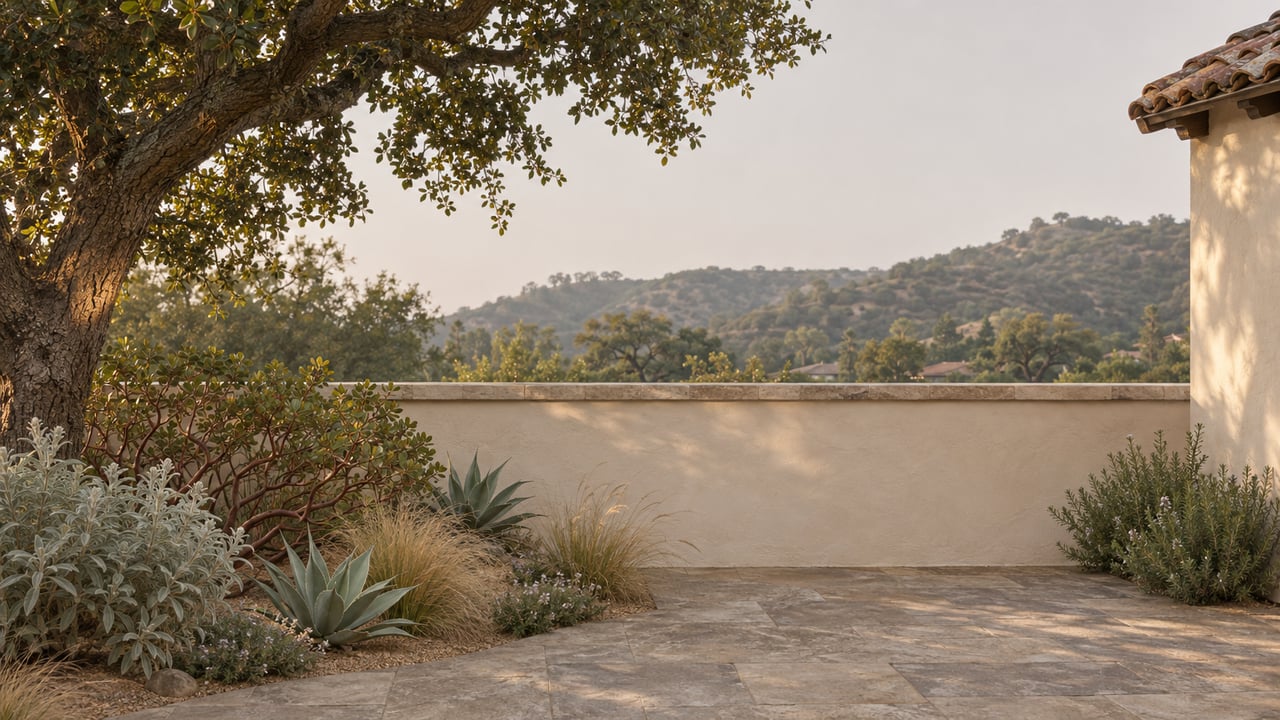
Crescenta Valley Water Bills Under Glendale's 2027 Rate Proposal
November 19, 2026
November 19, 2026
The alley behind the north side of Honolulu Avenue in the Montrose Shopping Park is the line between the City of Glendale and unincorporated Los Angeles County. On a map it looks like any other service alley. Houses a short walk apart on either side of that line can get their water, power and trash from different providers.
Under today's rate schedules, a Glendale address in the Crescenta Valley pays less for water than a house served by the Crescenta Valley Water District. Glendale Water & Power's proposed rates for January 2027 would shrink most of it. The proposal also adds a charge based on elevation, and on the higher foothill streets that charge would make the city's first-tier water cost more per gallon than CVWD's indoor rate. If you're comparing two houses across that line, plan for both water bills to change, and expect the bigger change on the Glendale side.
CVWD is the retail water provider for unincorporated La Crescenta, Montrose and Verdugo City. It also serves a small part of Glendale and La Cañada Flintridge, according to the district's 2025 Urban Water Management Plan. Its imported supply comes from the Metropolitan Water District through Foothill Municipal Water District, which acts as the wholesaler. Glendale Water & Power's regular water rates apply inside Glendale and its annexed territory. Since CVWD also reaches into part of Glendale, city limits alone don't tell you a house's water provider.
There's also a charge that never shows up on a CVWD water bill. CVWD lists a capital charge of $226.36 for fiscal year 2026 on a ¾-inch meter and collects it through the county property tax roll. If you compare only the utility bills a seller provides, the CVWD house will look a little cheaper than it is.
Here are the two current residential schedules for a standard single-family meter. GWP bills water by the hundred cubic feet, or HCF, which is 748 gallons. CVWD bills by the unit of 1,000 gallons. I converted GWP's prices to 1,000 gallons so the two columns can be compared directly.
| Current charge | CVWD, effective July 1, 2026 | GWP, current schedule |
|---|---|---|
| Monthly meter charge, ¾-inch | $48.10 inside the district | $27.02 |
| First-tier water, per 1,000 gallons | $6.01 within the indoor budget | $3.74, from $2.80 per HCF for 0 to 8 HCF |
| Next tier, per 1,000 gallons | $12.45 within the outdoor budget | $5.49, from $4.11 per HCF for 8 to 15 HCF |
| Highest tier, per 1,000 gallons | $19.73 above budget | $5.72, from $4.28 per HCF above 15 HCF |
GWP also adds a Phase III drought charge of $0.45 per HCF, which is in effect now. Even with it added, the Glendale side pays less for its first 1,000 gallons and about $21 less a month in meter charges.
CVWD's April 2025 rate study put the median single-family water bill at $91.12 a month for 6,000 gallons. Under the rates proposed at that time, the same bill would be $98.34. CVWD customers also pay a separate wastewater charge of $14.74 per person per month, effective July 1, 2026. The district's schedule uses a four-person household as its example, which comes to $58.96 a month.
The city side's rates have risen slowly. In September, Crescenta Valley Weekly reported that Glendale water rates had risen 7.5% since 2019, a period in which inflation totaled 29.2%. The proposal on the table would make up that difference all at once.
GWP is proposing five years of rate adjustments, with the first taking effect January 1, 2027 if the council approves them. Crescenta Valley Weekly reported a 53% average increase in the first year, followed by increases of 11%, 10%, 10% and 7% on the next four New Year's Days.
According to the city's Proposition 218 notice, a single-family home with a ⅝-inch or ¾-inch meter would pay a fixed charge of $42.00 a month. Usage would be priced at $4.09 per HCF for the first 10 HCF, or 7,480 gallons, and $6.92 per HCF above that. That puts the meter charge within about $6 of CVWD's.
The bigger change for a foothill buyer is the pump zone. GWP's new structure adds a per-HCF charge for the energy needed to pump water uphill. There are seven zones, set by elevation. The table below adds each zone's charge to the proposed first-tier rate and converts the total to 1,000 gallons, so you can set it next to CVWD's $6.01 indoor rate.
| GWP pump zone, elevation | Zone charge per HCF | First tier plus zone, per HCF | Per 1,000 gallons |
|---|---|---|---|
| Zone 1, 724 ft | $0.05 | $4.14 | $5.53 |
| Zone 2, 968 ft | $0.25 | $4.34 | $5.80 |
| Zone 3, 1,290 ft | $0.84 | $4.93 | $6.59 |
| Zone 4, 1,666 ft | $1.83 | $5.92 | $7.91 |
| Zone 5, 2,000 ft | $2.31 | $6.40 | $8.56 |
| Zone 6, 2,400 ft | $3.42 | $7.51 | $10.04 |
| Zone 7, 2,483 ft | $5.08 | $9.17 | $12.26 |
In Zone 3 and above, the city's first-tier price would be higher than what a CVWD customer pays for water inside the indoor budget. In Zone 7, the city's first-tier price would nearly match CVWD's outdoor-budget rate of $12.45. Today a Glendale address in the valley has a lower water bill. Under the proposal, that only holds at lower elevations.
Most of Glendale sits at those lower elevations. As Crescenta Valley Weekly reported from the Nov. 10 council meeting, GWP staff said about 90% of its water customers are in Zones 1 through 3, and Zone 7 has 47 customers. GWP's online bill estimator asks you to find your zone on its pump-zone map. It does not look up a zone by address. If you're looking at a Glendale-side house on a hillside street, find its zone before you think about an offer.
The proposal was first set for a hearing on Nov. 3. At the Nov. 10 meeting, more than 50 people spoke, and the council again continued the hearing without closing it, Crescenta Valley Weekly reported. The paper said the city had received 4,351 written protests at that point. The continued hearing was scheduled for Tuesday, Nov. 17, at City Hall, 613 E. Broadway. GWP's proposed rates page has the schedule and the full rate tables.
At that meeting, GWP staff showed examples of the first-year effect. Typical single-family households would see increases of $21 to $26 a month, and Zone 7 households would see $72 to $87 a month. One public speaker from the Verdugo Woodlands neighborhood estimated that the average bill would go from about $73 a month now to about $160 by 2031, according to Crescenta Valley Weekly's account. CVWD's own published schedule already runs through fiscal year 2028, so its rates will keep changing too.
Refuse service shifts the comparison the other way. Unincorporated La Crescenta and Montrose are a Los Angeles County residential franchise area served by Burrtec, with three carts collected weekly. The county's July 1, 2026 rate sheet puts regular service at $123.03 a quarter, which is $41.01 a month. The City of Glendale collects from single-family homes itself. Its posted rate sheet lists a 96-gallon cart at $58.63 a month, effective July 1, 2025.
Electricity is harder to compare without a household's actual usage. As of Oct. 1, 2026, Southern California Edison listed its average residential rate at 34.5 cents per kWh and a typical 500-kWh monthly bill at $188.64. Since November 2025, Edison has also charged a Base Services Charge of $0.80 a day, about $24.15 in an average month, for non-discounted customers. GWP's residential electric schedule has a customer charge of $0.75 per meter per day, with seasonal tiered rates. The Glendale News-Press reported that the city spread its approved electric increases over three years: 5% on Nov. 1, 2025, 2.95% on Nov. 1, 2026, and another 2.95% on Nov. 1, 2027. To confirm the electric provider for a specific house, use Edison's service area lookup.
The utility profile of a Crescenta Valley house belongs in the cost of owning it, the same way a roof near the end of its life does. These questions sort it out for two houses on opposite sides of the line:
A house with a large lawn on an upper Glendale street and a similar house a few blocks away on CVWD water could have water bills that rank differently in 2027 than they do now. That difference should be in the price analysis before you set an offer, not discovered after closing.
These figures are general information as of the dates shown. They are not legal, tax or financial advice, so please confirm current charges for any address directly with the provider and your own advisors.
If you're comparing homes on both sides of the line and want to work through the utility costs alongside condition and price, I'd be glad to go through the addresses on your list with you. Reach out to Ed Dorini. You can also browse current La Crescenta homes or read more about the La Crescenta-Montrose area. Let's Connect.
November 19, 2026
November 12, 2026
November 5, 2026
October 29, 2026
October 22, 2026
October 15, 2026
October 8, 2026
October 1, 2026
September 24, 2026
Ed works very hard for his clients in helping achieve their goals. Ed has the sophistication and experience needed to capture the attention of the affluent buyers you need to reach, negotiate our best deal and manage your transaction to a successful closing.